
The ROI of Presence in the Hybrid Workplace
As organisations rethink hybrid work, the question is shifting from how often people meet to what quality of presence is required to unlock trust, creativity and performance.
For much of the past decade, workplace technology has optimised for efficiency. We measured cost per seat, travel reduction, utilisation rates and meeting duration. Video conferencing scaled rapidly because it solved a clear problem: connection at a distance.
But in the hybrid era, a more nuanced challenge has emerged. Teams are technically connected yet often psychologically distant. Meetings are frequent, but alignment feels fragile. Collaboration is constant, but cohesion is uneven.
This tension raises a harder question for leaders: what is the return on presence?
From cost savings to value creation
The first phase of hybrid work was driven by cost logic. Fewer flights. Smaller footprints. Lower overheads. Technology proved its worth by keeping operations running.
The next phase is about value creation. Organisations are asking whether distributed teams can innovate at the same rate as co-located ones, whether culture can be sustained across time zones, and whether trust can form without informal proximity.
Research consistently links high-performing teams to psychological safety, shared identity and strong interpersonal trust. These are not abstract cultural ideals; they correlate with productivity, retention and innovation outcomes. Yet they are also highly sensitive to the quality of interaction.
Not all presence is equal. A thumbnail on a laptop screen does not replicate the embodied cues of full-scale interaction: eye contact, micro-expressions, spatial awareness and the subtle feedback loops that regulate conversation. When these cues degrade, so does relational bandwidth.
The ROI of presence begins here – in the difference between connection and co-presence.
The hidden cost of diminished interaction
Organisations rarely account for the cumulative cost of low-fidelity interaction. It shows up indirectly: misalignment that requires follow-up meetings, slower decision cycles, reduced creative risk-taking and higher attrition among early-career employees who struggle to form social bonds.
Hybrid work has also introduced asymmetry. When some participants are physically together and others are dialling in, the remote cohort often experiences reduced visibility and influence. Over time, this shapes promotion pathways, engagement scores and perceptions of fairness.
These effects are subtle but material. If innovation slows by even a few percentage points, or if critical talent leaves because connection feels transactional rather than human, the financial implications far outweigh savings from reduced travel.
Presence, therefore, should be viewed as a strategic variable, not an aesthetic one.
Presence as infrastructure
In previous generations, the office itself functioned as presence infrastructure. Architecture, proximity and routine created opportunities for spontaneous exchange and embodied interaction.
Today, that infrastructure must be redesigned.
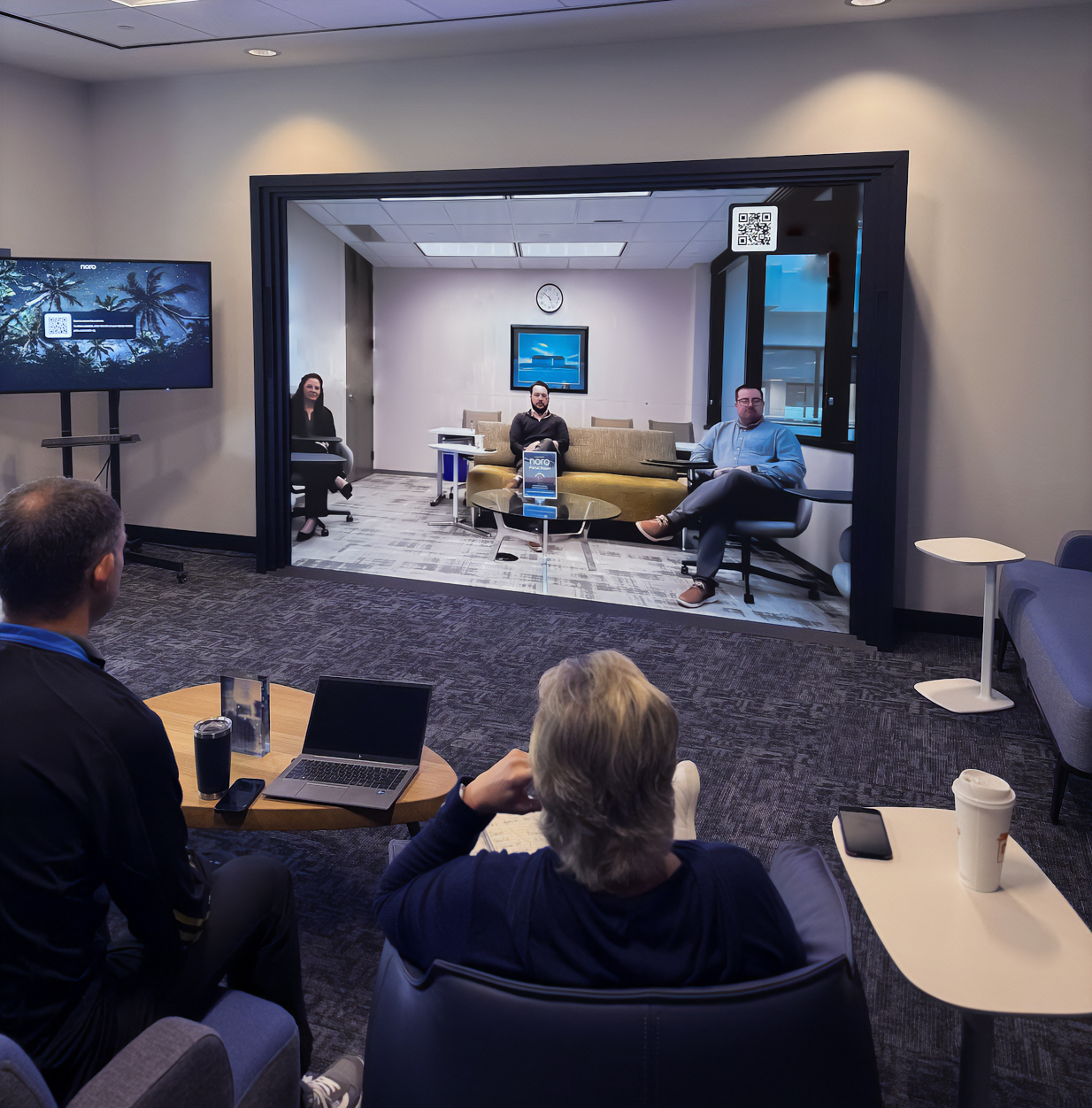
Immersive technologies are beginning to explore what high-fidelity remote presence can look like without requiring headsets or complex onboarding. The aim is not novelty, but normalcy – interactions that feel intuitive, life-sized and spatially coherent.
When remote participants appear at human scale, with natural eye lines and minimal perceptual distortion, conversation dynamics change. Interruptions decrease. Attention increases. Side conversations become possible. Informal rituals – greetings, pauses, laughter – re-emerge.
This is not about replicating the office. It is about restoring the social bandwidth that underpins collaboration.
A case study in immersive presence
One example of this shift is Noro, a life-size, full-body video environment designed to connect offices and teams without headsets or avatars. Rather than shrinking colleagues into tiles, Noro presents them at human scale within architectural frames that align sightlines and spatial cues.
In deployments across corporate offices and public institutions, organisations have reported higher engagement in cross-site meetings, reduced reliance on discretionary travel for routine collaboration, and improved participation from previously remote-marginalised teams. Leaders describe faster alignment between sites and stronger cultural continuity across geographies. While still an emerging category, such systems suggest that when presence is engineered intentionally, it can produce measurable operational and cultural returns.
The lesson is less about any single platform and more about the principle: fidelity changes behaviour.
Measuring the return
The challenge for senior decision-makers is translating presence into metrics. Several measurable indicators offer proxies:
- Decision velocity – Are cross-site teams resolving issues faster?
- Engagement and retention – Do distributed employees report stronger belonging?
- Innovation output – Are geographically dispersed teams generating new ideas at comparable rates?
- Travel optimisation – Can high-quality presence reduce unnecessary travel while preserving critical moments of physical gathering?
In this framing, presence does not replace physical co-location. It reallocates it. If routine interactions can occur with greater fidelity remotely, organisations can reserve travel for moments that truly require physical immersion.
The result is not simply cost reduction but smarter deployment of human energy.
A global workplace, rebalanced
The hybrid workplace is inherently global. Talent is distributed. Teams span regions. Real estate strategies are being recalibrated in London, New York, Singapore and beyond.
In this context, presence is also a question of equity. High-fidelity interaction can level the playing field between headquarters and satellite offices, between senior leaders and remote hires, between mature markets and emerging ones.
Organisations that treat presence as infrastructure are effectively investing in cultural coherence at scale.
What leaders should consider next
As technology evolves, the strategic conversation should move beyond feature comparisons to experiential outcomes. Leaders might ask:
- What level of presence is required for our most critical work?
- Where are we experiencing friction that may stem from degraded interaction?
- How does our technology stack shape power dynamics in meetings?
- Are we designing environments that support human cognition and trust?
The future of work will not be defined by how often people are in the office, but by how effectively they experience one another across distance.
The ROI of presence lies in recognising that collaboration is not just information exchange. It is relational work. And relational work, when done well, compounds.
In the hybrid era, presence is no longer a by-product of place. It is a strategic choice.
Tommaso Trionfi is Co-founder and CEO of Noro, an immersive technology company building life-size video portals for enterprise collaboration. He previously founded Wimba, a virtual classroom platform acquired by Blackboard.

More posts from our team

.jpg)
Join us in making distance irrelevant
Ready to transform your meetings and energize your teams? Contact us to learn more about piloting Noro in your organization.
If you are in New York, San Francisco, Atlanta, Chicago or London come check out our demos.


Check out our sister company sharedstudios.com, which programs meaningful conversations, classes and more across Noro portals worldwide.
Copyright © 2024 Noro. All Rights Reserved.


.jpg)
